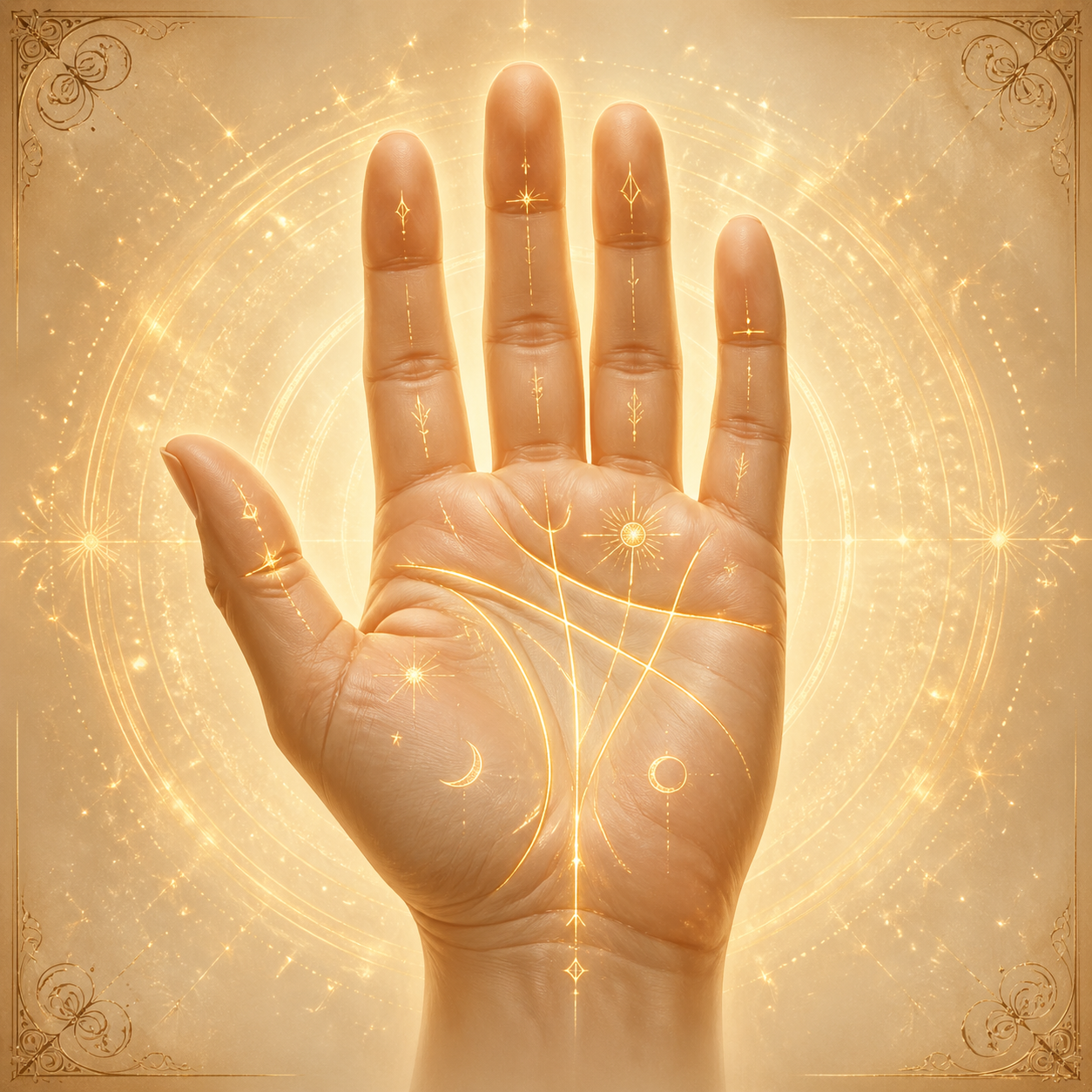
Palm Reading Lines
Complete Guide to Every Line on Your Hand
Your palm holds a map of lines, each carrying a different meaning across Western, Chinese, and Indian palmistry traditions. This guide explains every major line, where to find it, and what each tradition says it reveals.
Scan your palmA Map Written on Your Hand
Palmistry identifies six primary lines on the human palm. Three of them, the heart line, head line, and life line, appear on nearly every hand. The remaining three, the fate line, sun line, and marriage line, vary in presence and prominence from person to person. Each line occupies a specific region of the palm and carries distinct meanings across Western chirognomy, Chinese hand analysis, and Indian Hasta Samudrika Shastra.
The Heart Line
Also called: Love Line, Emotional Line
The heart line is the uppermost horizontal line on your palm. It begins near the edge below the little finger and curves across toward the index or middle finger. On some hands it reaches all the way to the index finger base. On others it ends between the index and middle fingers.
Western
In Western palmistry, the heart line reflects emotional temperament and relationship patterns. A long, deeply curved line suggests warmth and expressiveness. A straighter heart line indicates someone who processes emotions through logic rather than instinct. Breaks in the line are read as significant emotional events or turning points.
Chinese (手相学)
Chinese hand reading calls this the Heaven Line (天纹). It represents a person's emotional foundation and capacity for connection. The line is examined alongside the head and life lines to form a complete picture. A clear, unbroken Heaven Line indicates emotional stability and strong family bonds.
Indian (Hasta Samudrika)
In Hasta Samudrika Shastra, the heart line reflects the influence of the heart chakra on daily life. Its depth and clarity indicate the strength of devotion, whether directed toward relationships, spiritual practice, or creative pursuits. Branches rising from the line are considered signs of emotional generosity.
The Head Line
Also called: Wisdom Line, Intelligence Line
Quick Reference
Western palmistry reads the head line as the indicator of intellectual style. A straight head line suggests analytical, structured thinking. A curved head line points toward creativity and imagination. The length of the line does not measure intelligence but rather how deeply a person tends to think before acting.
Known as the Human Line (人纹) in Chinese palmistry, it represents mental clarity and decision-making capacity. A clear Human Line without islands or breaks indicates sound judgment. Chinese practitioners pay close attention to where this line begins relative to the Life Line.
Indian palmistry connects the head line to the planet Mercury and the mind's capacity for learning. The line's depth reflects concentration ability, while its curvature shows the balance between practical knowledge and abstract thought. Forks at the end are read as versatility.
The Life Line
Also called: Vitality Line, Earth Line
A short life line does NOT mean a short life. This is the single most common palmistry myth. The life line reflects vitality, energy levels, and major life changes. Its length has no correlation with lifespan. Every credible palmistry tradition agrees on this point.
The life line curves around the base of the thumb, starting between the thumb and index finger and arcing downward toward the wrist. It is usually the most visible line on the palm. On many hands, it begins at the same point as the head line.
Western
In Western palmistry, the life line maps vitality, physical energy, and major life transitions. A wide arc sweeping well into the palm suggests an energetic, adventurous nature. A line that stays close to the thumb indicates a more cautious, home-centered temperament. Breaks can signal periods of significant change rather than health events.
Chinese (手相学)
The Earth Line (地纹) in Chinese palmistry represents the body's constitutional strength and the person's relationship with family and home. Chinese practitioners examine the line's depth rather than its length. A deep, clear Earth Line indicates robust physical health and strong family roots.
Indian (Hasta Samudrika)
Indian palmists connect the life line to the planet Venus and the mount of Venus that it encircles. The line reveals a person's life force (prana), physical constitution, and capacity for enjoyment. A well-formed life line with no islands suggests steady vitality throughout life. Small branches rising upward are considered marks of ambition.
The Fate Line
Also called: Career Line, Destiny Line, Saturn Line
The fate line runs vertically up the center of the palm, from near the wrist toward the middle finger. Not everyone has a fate line. Some people have a strong, unbroken line. Others have fragments, and some have none at all. The absence of a fate line is not negative. It often appears on people who prefer to forge their own path rather than follow a conventional career trajectory.
Western palmistry reads the fate line as a map of career development and external circumstances that shape a person's working life. The line's starting point matters. A fate line beginning at the wrist suggests early career clarity. One starting mid-palm may indicate a later vocational calling or a career shift in the middle years.
Chinese palmistry treats the fate line as a reflection of social standing and how external fortune intersects with personal effort. Indian palmists associate it with the planet Saturn and read it as a measure of how destiny and free will interact over a lifetime. A deep fate line in Indian reading suggests a life strongly shaped by circumstance, while a faint or absent line points toward self-determination.
The fate line is the most variable of the six major lines. It can change visibly over the course of a decade, making it one of the most dynamic features practitioners track across readings.
The Sun Line
Also called: Apollo Line, Success Line, Line of Brilliance
The sun line runs vertically toward the ring finger, often parallel to the fate line but positioned closer to the ring-finger side of the palm. It may be short, appearing only near the top of the palm, or extend further down. Many people do not have a visible sun line.
What It Reveals
Across all three traditions, the sun line relates to public recognition, creative fulfillment, and personal satisfaction with one's achievements. Western palmistry connects it to fame and artistic talent. Chinese hand analysis views it as a marker of social influence and reputation. Indian Hasta Samudrika associates it with the god Apollo and reads a clear sun line as an indicator of creative brilliance, charisma, and the ability to attract success. A strong sun line alongside a weak fate line suggests talent that finds its own audience, regardless of conventional career planning.
The Marriage Line
The marriage line (also called the relationship line or affection line) is a short horizontal crease found on the edge of the palm between the base of the little finger and the heart line. Most people have one to three of these lines. Despite the name, modern palmists read it as reflecting significant relationships and deep emotional bonds rather than strictly legal marriage.
Read the full Marriage Line guideWhat do your lines say?
Upload a photo of your palm and get an instant AI reading of all six lines.
Discover now