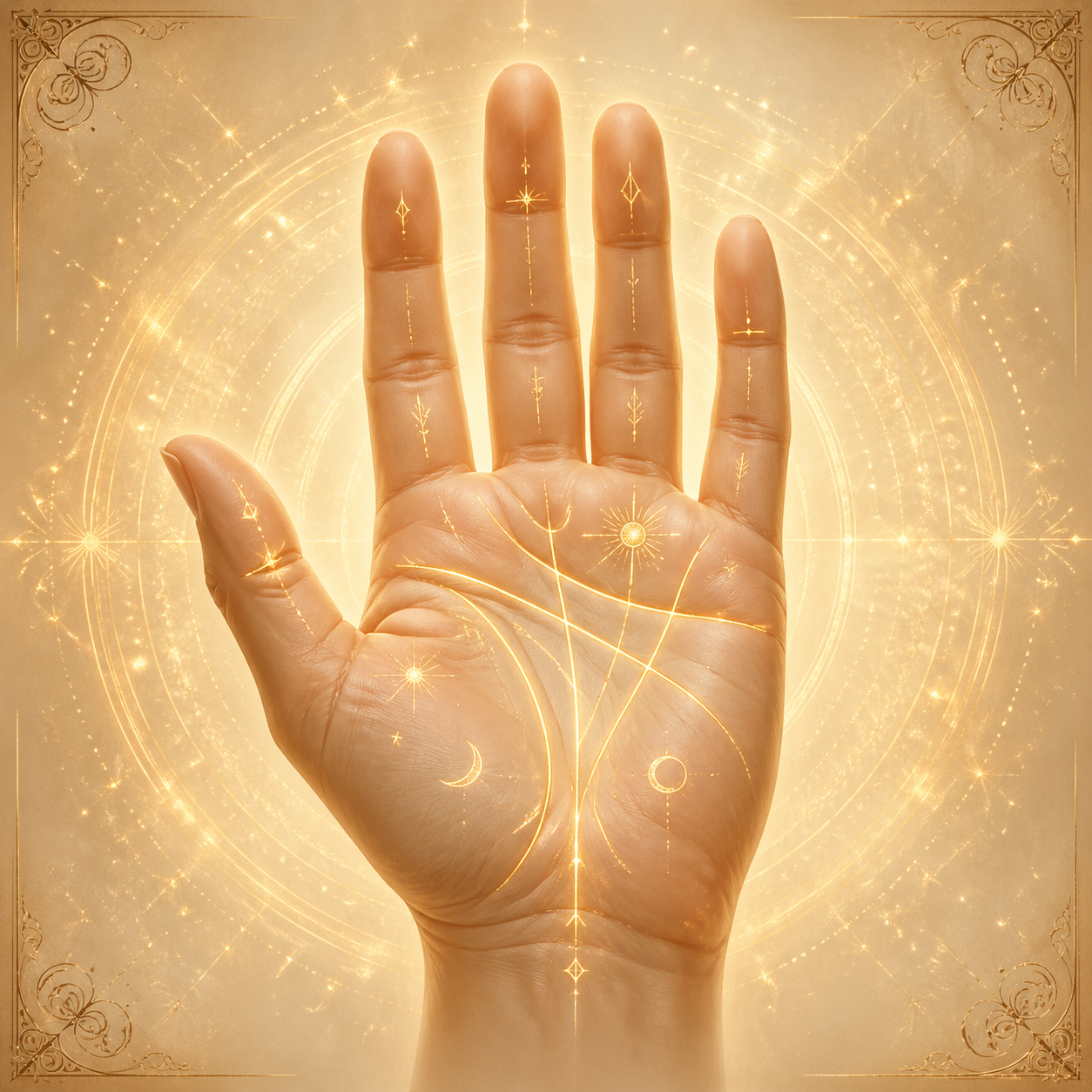
Palm Reading for Male
Start with the hand you use most
For palm reading for male, start with your dominant hand in Western practice, then compare the other palm. Chinese tradition often uses the left hand for men; Indian Hasta Samudrika traditions commonly begin with the right. There is no single rule shared by every school. This guide places those customs side by side and explains lines and shapes as prompts for reflection and entertainment, not predictions of health, lifespan or relationship outcomes.
Upload your palm photoWhich hand should a man read?
Choose a convention before interpreting a line. A left-handed man can begin with his left palm under the dominant-hand approach; being male does not automatically make the right hand dominant. Comparing both hands adds context without requiring you to select a supposedly correct palm.
Western practice: dominant and non-dominant
Many Western readers treat the hand used most often as a picture of current habits and choices. The non-dominant hand is read as a symbol of starting tendencies or potential. If you write with your right hand, begin there; if you write with your left, begin with that one. These are interpretive conventions rather than measurements of character.
Chinese tradition: men left, women right
The familiar Chinese convention of 'men left, women right' gives a male reading a left-hand starting point. Some readers compare the opposite hand as well. Keep the convention visible when discussing a reading: a left-palm interpretation and a dominant-palm interpretation may emphasize different things without describing different people.
Indian Hasta Samudrika: a right-hand starting point
In Indian Hasta Samudrika, some schools traditionally begin with the right hand for men and the left for women. Practice varies between readers and lineages, and both palms may be considered. Ask which convention a reader follows rather than assuming every Indian reading uses the same method.
For a simple comparison, note your dominant hand, look at one feature on each palm and describe what you can actually see. Do not turn a difference into a verdict about your future. None of these traditions should replace medical advice or decisions about relationships.
The four major lines on a man's palm
The same basic landmarks are used for men and women. First locate each crease, then notice its direction and clarity. A faint, short or absent line is not a defect. Follow the links for diagrams before assigning a symbolic meaning.
Life line: around the base of the thumb
The life line curves around the thumb's fleshy base. Palmistry associates it with energy, everyday rhythm and feeling grounded. Its length does not measure how long you will live, and breaks do not diagnose illness. Use it as a prompt to reflect on rest, activity and the routines that support you.
Head line: across the middle of the palm
The head line usually runs across the middle of the palm, beginning near the thumb and index finger. Readers associate a straighter course with practical focus and a sloping course with imagination. Those are storytelling lenses, not intelligence scores. Think about how you approach choices rather than whether a line is 'good' or 'bad'.
Heart line: beneath the fingers
The heart line lies higher on the palm, beneath the finger bases. It is traditionally linked with emotional expression and connection. Notice its curve and where it ends, but avoid treating it as evidence of loyalty, compatibility or someone's feelings. A useful reflection asks how you communicate care in real life.
Fate line: vertically toward the middle finger
The fate line, also called the career line, may run upward through the center of the palm. Some hands have a strong line; others have several fragments or none. Readers use it to discuss direction, responsibility and changing priorities. Its presence cannot guarantee career success, and its absence does not mean you lack purpose.
See the lines on your own palm
Return to the existing photo upload to explore a personal reading. Use a clear, well-lit palm image and treat the interpretation as a starting point for reflection.
Try a palm photo readingEarth, water, fire and air hand shapes
The four-element framework combines palm proportions with finger length. Compare the palm itself rather than the entire hand: is it roughly square or longer than it is wide? Then consider whether the fingers look short or long in proportion. Borderline shapes are common; no category is exclusively male.
Earth: square palm, shorter fingers
An earth-shaped hand pairs a broadly square palm with relatively short fingers. Symbolic readings emphasize practicality, steadiness and learning by doing. Use that description to ask where hands-on experience helps you, not to assume a profession or a fixed personality.
Water: long palm, longer fingers
A water-shaped hand combines a longer palm with long fingers. Readers often associate it with sensitivity, imagination and attention to emotional atmosphere. This can prompt reflection on boundaries and creative interests; it does not establish how sensitive someone actually is.
Fire: long palm, shorter fingers
A fire-shaped hand has a longer palm and comparatively short fingers. Traditional descriptions emphasize initiative, enthusiasm and momentum. Consider when quick action serves you and when a pause helps. The shape is not proof of leadership or a reason to take risks.
Air: square palm, longer fingers
An air-shaped hand pairs a square palm with long fingers. Symbolic readings highlight curiosity, communication and analysis. Try it as a question about how you gather information or explain ideas, not as a measure of ability or a prediction of achievement.
Hand shapes and line patterns do not determine masculinity, worth or destiny. Let a category invite a question, and leave it behind if the description does not fit your experience.
Marriage lines on a man's hand
Look along the outer edge of the palm beneath the little finger, above the heart line. The small horizontal creases there are often called marriage, relationship or affection lines. An edge-on view may show them more clearly than a flat photo. They use the same landmarks on men's and women's hands.
The number of creases is not a reliable count of marriages, and their position cannot establish a wedding date. Avoid using them to judge a partner or promise a relationship outcome. Explore their traditional interpretations as stories about connection, not instructions for your love life.
Explore the marriage line guideTurn curiosity into reflection
Explore your palm with the existing AI photo reading, then compare the interpretation with your own experience. For entertainment and reflection only, not medical, lifespan or relationship predictions.
Explore your palm reading