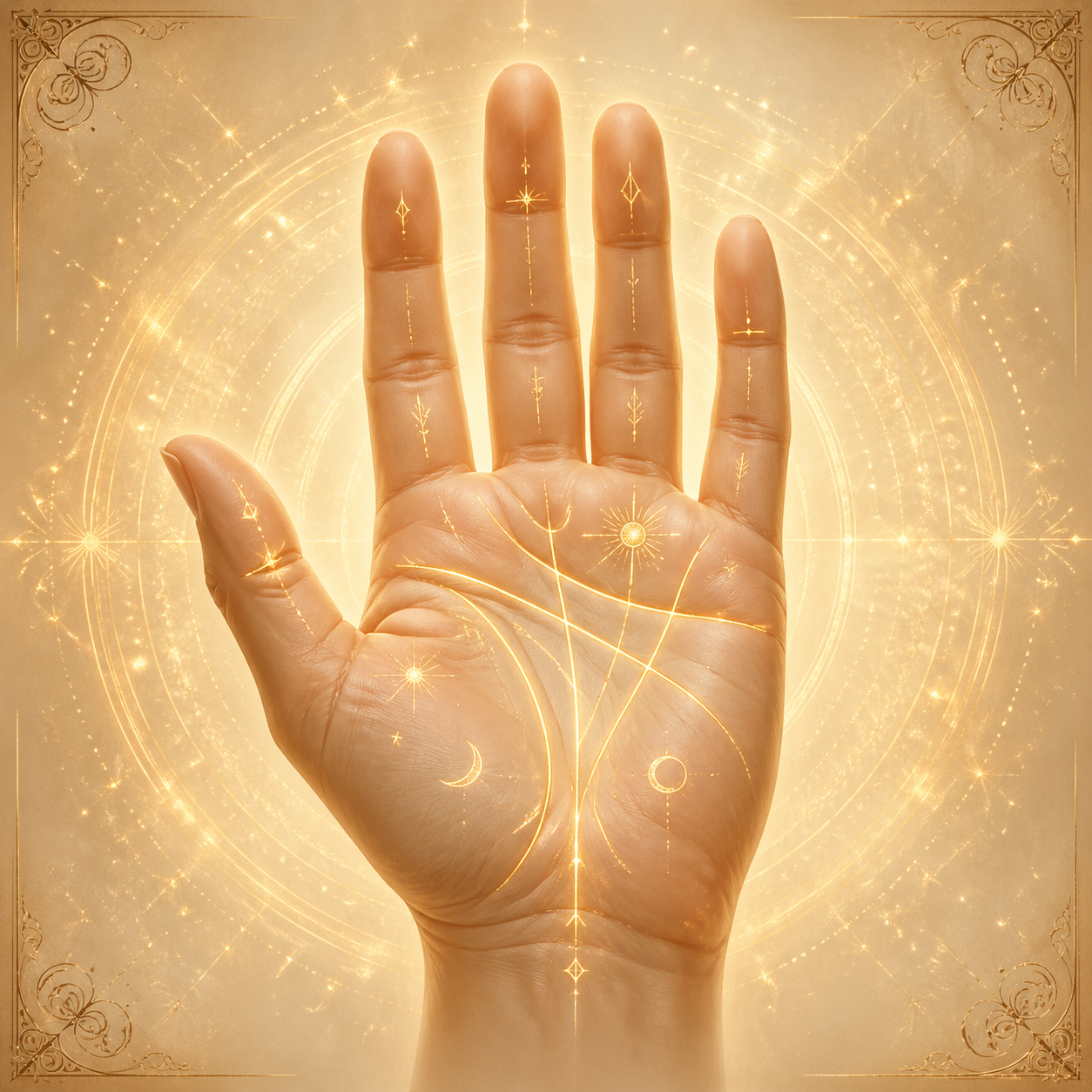
Palm Reading for Female
Your hands, your choices — not a fixed destiny
Palm reading for female has no universal hand rule. Many Western readers start with your dominant hand; the Chinese 'men left, women right' convention starts with a woman's right palm; some Indian schools begin with her left. If you are left-handed, the Western approach starts on the left. Compare both palms while keeping your chosen tradition in mind. Here, lines and shapes invite reflection on your own priorities, not judgments about femininity or predictions of health, lifespan or marriage.
Explore your palm photoWhich hand should a woman look at?
Before looking for a meaningful crease, name the method you are using. A right-palm rule based on gender and a dominant-hand rule answer different questions. Neither makes the other palm irrelevant, and neither is a scientifically established way to determine your future.
Western: begin with the hand you use most
In many Western approaches, the dominant hand symbolizes habits you have developed, while the other hand represents starting tendencies. For a left-handed woman, this means beginning with the left rather than automatically choosing the right. If you use different hands for writing and other tasks, describe that context instead of forcing yourself into a rigid category.
Chinese: the women-right convention
The saying 'men left, women right' gives women a right-hand starting point in a familiar Chinese convention. It is a cultural reading framework, not a claim that all women share the same personality. Some readers also compare both hands or follow different schools. State the convention so a right-palm observation is not confused with a dominant-hand interpretation.
Indian: a left-hand convention in some schools
Some Indian Hasta Samudrika lineages traditionally read a woman's left hand first and a man's right. Other readers use dominance or consider both palms together. Ask about the reader's approach, especially if you are left-handed: beginning with the left can reflect either a gender convention or dominance, but those are not the same explanation.
Try a two-hand observation: locate the head line on each palm, note its visible direction, then write down which convention you chose. Differences can support a conversation about continuity and change. They do not prove that one hand is your 'real' self or that a particular future is inevitable.
Our men's guide uses the same palm landmarks but discusses the Chinese men-left and Indian men-right starting points. This women's guide focuses on the opposite traditional starting points, left-handed women and choosing interpretations without gender expectations. Compare the palm reading for male guide.
Four palm lines: questions, not labels for women
Find the physical landmarks before interpreting them. The prompts below leave room for work, friendship, caring responsibilities, creative projects or whatever matters to you. No crease assigns a woman a role, and a light or missing line is not a personal shortcoming. Open each guide for its location and diagram.
Life line: what helps you feel supported?
Look for the arc around the base of the thumb. Palmistry often connects this line with vitality and everyday experience; use that symbolism to ask what gives you room to rest and recharge. It cannot measure lifespan, diagnose a health condition or say whether a woman will have children. A short arc does not mean a short life.
Head line: how do you make space to think?
The head line crosses the middle of the palm. Traditional readings contrast directness with imagination depending on its course. Rather than calling women naturally intuitive or emotional, ask how you balance planning, learning and experimentation in your own decisions. Its depth cannot grade intelligence, and a fork cannot determine your suitability for a profession.
Heart line: which boundaries matter to you?
Near the finger bases, the heart line is a symbolic starting point for feelings and connection. Reflect on expressing needs, giving affection and protecting personal boundaries across friendships as well as romance. A curved or straight line does not make someone a better partner. It cannot tell you another person's feelings or whether a relationship will succeed.
Fate line: how do you define a meaningful path?
A vertical line toward the middle finger is commonly called the fate or career line. For a woman's reading, avoid reducing its meaning to paid employment or judging a pause in work. Consider changing ambitions, study, independent projects or care on your own terms. A faint or absent line does not imply lack of purpose or inevitable financial difficulty.
Look at your own lines before reading meanings
Return to the existing upload tool with a clear palm photo. Treat the reading as reflective entertainment, not advice about health, fertility or relationships.
Open the palm upload toolEarth, water, fire and air: four symbolic hand shapes
The Western four-element framework combines palm proportions with finger length. These are loose visual categories, not biological types. Many hands mix features, and the same shape can be discussed in any gender. Use the questions as invitations, not a test of how a woman should behave.
Earth: square palm, shorter fingers
An earth-shaped hand is traditionally associated with practical, tangible activity. Ask which routines help you feel steady and which have become restrictive. That reflection can fit a builder, artist, student or parent; it is not a reason to assign women domestic duties or dismiss their imagination.
Water: longer palm, longer fingers
Water symbolism emphasizes sensitivity and noticing nuance. Consider when attention to other people is helpful and when you need a boundary or time alone. Long fingers do not prove emotional fragility, and women with this shape have no obligation to be caregivers or to absorb everyone else's feelings.
Fire: longer palm, shorter fingers
A fire-shaped hand is often linked to initiative and momentum. Reflect on projects you want to begin and how you choose a sustainable pace. Assertiveness is not less feminine, and short fingers cannot show that someone is reckless. The symbol is useful only if it helps you describe your actual experience.
Air: square palm, longer fingers
Air readings commonly highlight ideas, questions and communication. Ask where discussion clarifies a choice and where more thinking delays action. This is not a claim that analytical women are detached, nor that a hand shape ranks reasoning ability. Your interests and behavior offer better evidence than proportions.
If your palm falls between categories, leave it there. Perspective, posture and a photograph can change how proportions look. No hand shape is superior, and none provides a medical or psychological assessment.
Marriage lines and the heart line are different landmarks
The small creases on the palm's outer edge below the little finger are commonly called marriage or relationship lines. The heart line is the longer crease running below the fingers across the palm. Reading them together can prompt reflection on closeness and communication, but counting edge creases is not counting future marriages.
For women, these marks are sometimes burdened with claims about marriage age, fertility or a partner's loyalty. They cannot establish any of those things, predict separation or define your worth. Whether you are single, partnered or uninterested in marriage, decisions belong to you and the people involved, not to a line.
Locate the marriage line and explore its traditional symbolism.Make the reading a conversation with yourself
Explore the palm you choose, compare traditions and keep what helps you reflect. For entertainment and reflection only — no promises about health, lifespan or love.
Try a palm photo reading